Best Humidity for Cigars: A Practical RH Guide
For most home cigar storage, 65% to 69% relative humidity is a useful starting range. Stability and smoking performance matter more than chasing one perfect number.
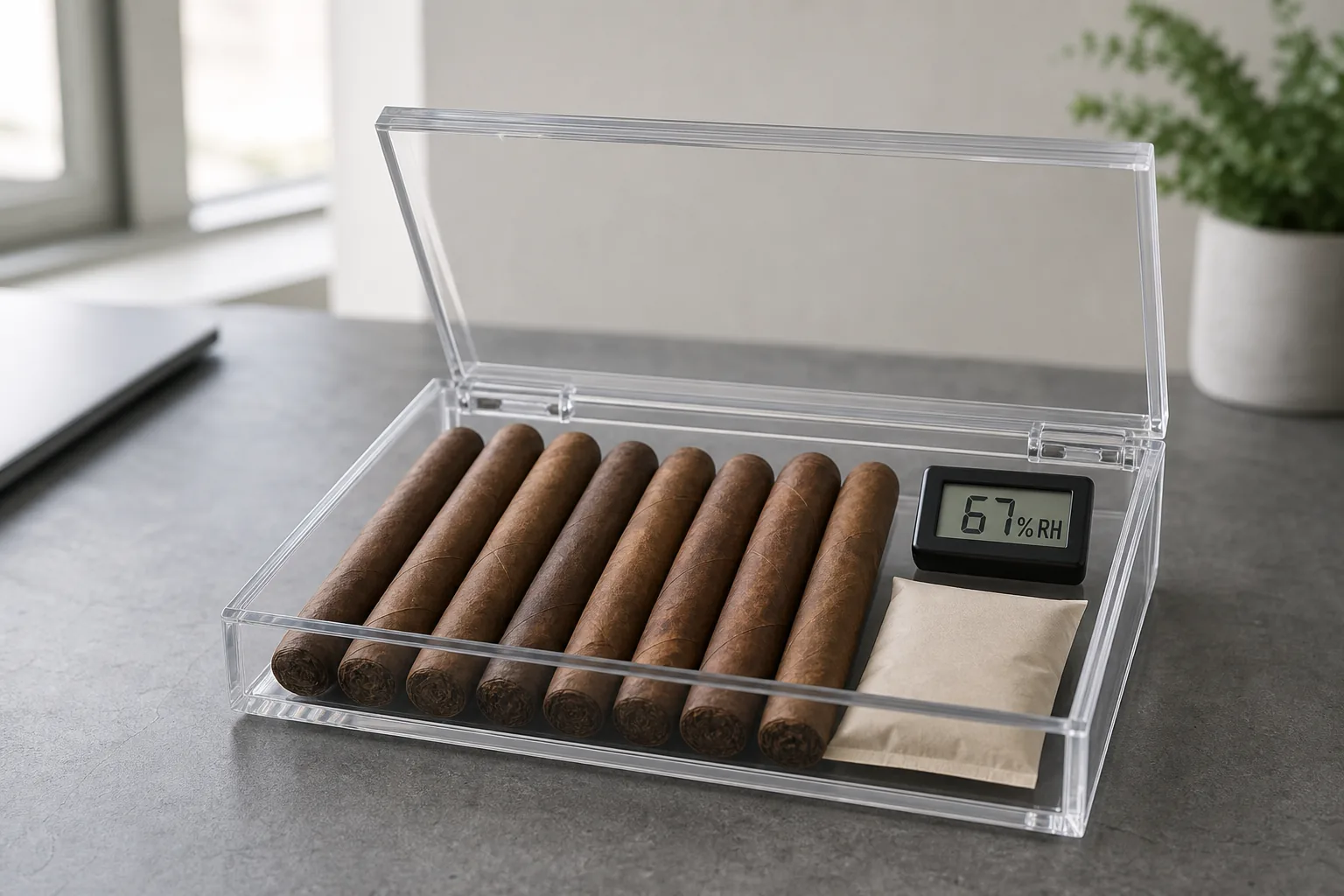
The best humidity for cigars is usually between 65% and 69% relative humidity for a well sealed home humidor. Start around 69% if you want a simple default. Try 65% if your cigars feel soft, struggle to stay lit, or live in an airtight container in a humid climate.
There’s no single reading that works for every cigar, container, and climate. A stable 67% that produces a clean burn is more useful than a humidor that swings between 62% and 72% while you chase the old 70/70 rule.
What does relative humidity mean?
Relative humidity, usually shortened to RH, measures the amount of moisture in the air compared with the maximum the air can hold at that temperature. Your hygrometer reports this as a percentage.
Cigar tobacco exchanges moisture with the surrounding air. When storage stays too dry, the cigar loses moisture. When it stays too humid, the cigar absorbs more. The change happens gradually, which is why corrections should also be gradual.
A practical cigar humidity range
| RH level | When it may fit | What to watch |
|---|---|---|
| 62% to 65% | Airtight storage, humid climates, easier burning, some long term storage | Cigars becoming firm, fragile, or fast burning |
| 65% to 69% | Practical range for many premium cigars and well sealed containers | Smoking performance and wrapper condition |
| 69% to 72% | Wood humidors that lose moisture, dry climates, smokers who prefer a softer cigar | Spongy texture, hard draws, relights, or mold |
| Above 72% | Usually not needed for routine storage | Swelling, poor combustion, mold risk, and beetle risk when heat is also high |
These are working ranges, not promises. A humidity pack’s printed level isn’t always the exact reading you’ll see inside the container. The seal, amount of wood, number of cigars, room climate, and hygrometer accuracy all affect the result.
Why 70/70 isn’t a requirement
The traditional 70/70 guideline means 70% RH at 70°F. It’s easy to remember, but cigars don’t fail because a humidor reads 67% instead of 70%.
Many cigars burn more cleanly in the mid to upper 60s. Lowering humidity slightly can help when a cigar repeatedly needs relights, feels overly soft, or produces a tight wet draw. The correction should take days or weeks, not hours.
Signs your cigars are too dry
- The wrapper feels brittle or begins cracking.
- The cigar feels unusually light or hard.
- The foot burns quickly and hot.
- The flavor becomes sharp, dry, or thin.
- The wrapper splits when cut or smoked.
A dry cigar isn’t always ruined, but fast rehydration can split the wrapper as the filler expands. Move it into stable controlled storage and let moisture return slowly. Severe dryness can permanently reduce oils and flavor even if the cigar becomes flexible again.
Signs your cigars are too humid
- The cigar feels spongy or swollen.
- The draw is tight even after a proper cut.
- The cigar repeatedly goes out.
- The smoke tastes musty or muted.
- The wrapper splits as the cigar warms.
- Fuzzy growth or an unpleasant odor appears.
If you see fuzzy growth, isolate the affected cigar and inspect the rest of the collection. Don’t assume white growth is harmless plume. Mold can appear in several colors, including white, and a questionable cigar isn’t worth smoking.
How temperature affects cigar storage
Humidity is only half of storage. Keep the humidor away from direct sun, hot cars, heating vents, and rooms with large temperature swings. Heat increases the chance of tobacco beetle activity and makes humidity control harder.
You don’t need to panic over a brief minor change. Repeated heat and large swings are the bigger concern. Choose a cool interior location where conditions remain consistent.
Wood humidors vs. airtight containers
A wood humidor absorbs and releases moisture. A new one must be seasoned, and a loose seal may require more humidification or a higher rated pack to hold the desired internal RH.
An acrylic humidor or food safe plastic container holds moisture more efficiently. Because it doesn’t absorb water like wood, a 69% pack can produce conditions that feel wetter than expected in a very tight container. Many smokers use 65% or 69% in airtight storage.
Our humidor guide compares storage types. If you own a new wood box, follow the separate guide on how to season a humidor before adding cigars.
How to check whether your hygrometer is accurate
Don’t make storage changes based on an untested gauge. Digital hygrometers are usually easier to read than inexpensive analog dials, but any unit can be off.
- Place the hygrometer in a sealed bag or container with a calibration kit or a known humidity pack.
- Leave it closed long enough for the environment to stabilize according to the calibration product’s instructions.
- Compare the display with the expected RH.
- Adjust the hygrometer if it supports calibration, or record the difference.
- Repeat the test if the reading begins behaving unpredictably.
How to change humidity safely
Change one thing at a time. Replace exhausted humidity packs, confirm the seal, and give the container time to settle before making another adjustment. Don’t add an open cup of water to a humidor full of cigars and don’t wet the cigars directly.
Humidity packs become firm as they’re exhausted. Replace them before they turn completely hard. Use the quantity recommended for the container’s capacity, not only the number of cigars currently inside.
Cigar Grail includes a humidity pillow with online cigar shipments so the cigars remain protected in transit. Once they arrive, move them into your regular controlled storage rather than treating the shipping package as a permanent humidor.
The practical answer
Start between 65% and 69% RH, keep the temperature stable, and judge the result by how the cigars feel, cut, draw, and burn. If they’re soft and hard to keep lit, move slightly lower. If they’re firm and fragile, correct upward slowly. Consistency matters more than hitting one perfect number.